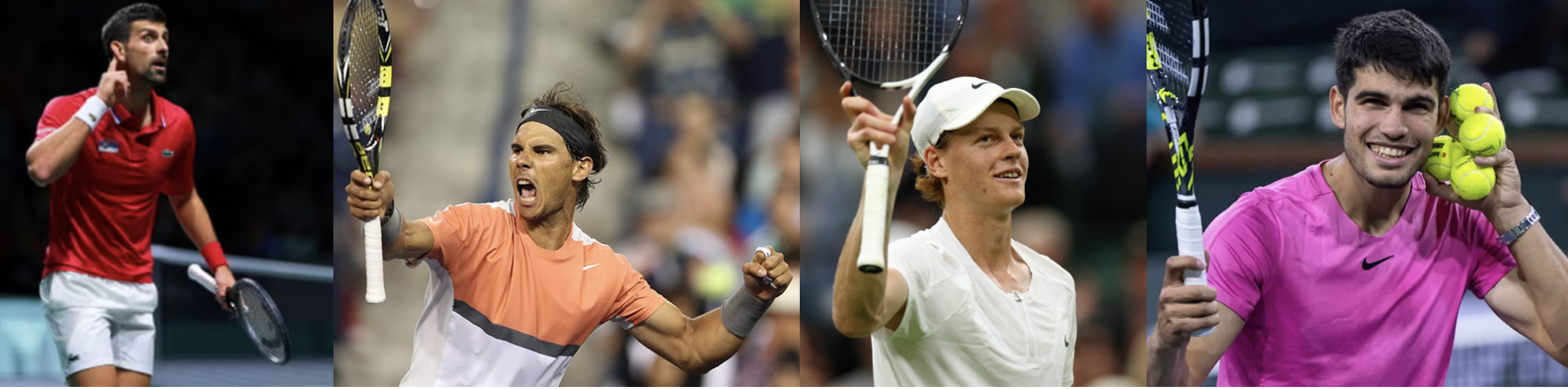

Throughout 2025, the two current titans of the court, Carlos Alcaraz and Jannik Sinner, have shared the four Grand Slams between themselves. The Italian began the rout, knocking off Alexander Zverev to claim his second straight Australian Open back in January. Alcaraz, however, would strike first in the battles between the planet’s top two, rallying from two sets down, two championship points down against his great rival to pull off the comeback of all comebacks at Roland Garros.
Sinner struck back at Wimbledon, overturning a one-set deficit of his own to end Alcaraz’s two-year reign at the All England Club. At Flushing Meadows, the pair would meet in a third straight slam final, this time with the Spaniard coming out on top and underscoring his status as the best player in the world in 2025, ending Sinner’s streak of hard-court Slam triumphs at three.
Alcaraz and Sinner Top the Rankings
After their rivalry played out in three of the four major finals, the aftershocks landed in the ATP rankings, with Alcaraz at the summit and Sinner not too far behind. The chasing pack? A million miles away, with second-place Sinner posting more than double the points of Alexander Zverev, firmly planted at number three. In pure arithmetic terms, the German is statistically closer to the world number 150 than to number two—a ranking gap that defies belief.
Take a look at the betting odds for next year’s slam, and you will see the huge disparity between the top two and the chasing pack in real time. Take next January’s Australian Open, for example. Those who bet on sports at Bovada can see that Sinner is priced as the 19/20 favorite, with Alcaraz just behind at 6/4. Then comes Novak Djokovic at a whopping 14/1, followed by Zverev at 20/1. That’s quite a lot for those looking to place a bet to absorb, but it’s important to recognize just what’s going on here.
Pause for a moment. When, if ever, have we seen such separation at tennis’s summit? Well, here are four such occasions where two players – sometimes just one – were a head and shoulders above the rest of their contemporaries.
2017: Nadal and Federer’s Last Hurrah
Rewind to 2017, when the tennis world was gripped by the renaissance of two legends. Rafael Nadal, reborn after injury, barreled to year-end No. 1 with 10,645 points and 10 titles, headlined by reclaiming his throne as the King of Clay in Paris after three years away, as well as his third triumph at the US Open. Roger Federer, meanwhile, was the script’s ageless wonder: rolling back the years at age 36 to rack up 9,605 points, as well as two Grand Slams in Melbourne, and a record-breaking eighth crown at Wimbledon—swatting away Father Time on his way to a 19th major.
What about the rest? Grigor Dimitrov, talented but inconsistent, finished with just 5,150 points—over 5,000 points behind the second-place Federer. Stop and do the math: that’s a void so massive it called to mind the classic Federer-Nadal duels of the noughties, when the two superstars ruled over the court with an iron fist. That’s perhaps the most surprising statistic of them all: 2017 wasn’t even prime Rafa and Roger, and they were still miles clear of the rest.
2016: Murray’s Relentless March, Djokovic’s Reluctant Surrender
In 2016, Andy Murray unleashed a season for the ages: Nine titles—including a heroic Wimbledon defense and second consecutive Olympic gold—saw the Scottish superstar grind his way to 12,410 points and his maiden year-end No. 1 designation. Novak Djokovic, still magnificent, finished with 11,780 points after his 122-week stay atop the rankings was finally broken.
But zoom out and you’ll see just how good the top two were that year. Milos Raonic’s 5,450 points barely registered by comparison, with the gap between second and third almost 6,500 points. Fourth-placed Stan Wawrinka was a further 1,000 points behind, while Rafa Nadal was down in ninth, and Federer didn’t even crack the top 15. If that doesn’t tell you how dominant Murray and Nole were, nothing will.
2015: Djokovic’s Masterclass
Peel back the curtain on 2015, and the stats become simply staggering. Novak Djokovic orchestrated pure numerical brilliance, finishing with 16,585 points—a tour record. His three Grand Slams and five Masters 1000 crowns were more than just badges of dominance; each trophy was an exclamation point on an 82-6 campaign rarely seen in the Open Era.
The numbers are unyielding: Andy Murray, second, accrued just 8,945 points; Federer, third, finished with 8,265. That 7,640-point gulf between Djokovic and Murray—nearly a doubling—stands as one of the ATP’s greatest ever chasms. What caused it? Djokovic’s all-court game had evolved into a fortress: relentless defense, surgical precision, and a psychological edge that left rivals not only outplayed but out-thought.
2013: Nadal’s Resurrection
And what of 2013? After orthopedic heartbreak and months under the medical spotlight, Rafael Nadal returned with thunder and fire. He carved out 13,030 points — dissecting surfaces for 10 titles, including the French and US Opens. Djokovic, for all his fight, ended with 12,260. But the telling number comes just below: David Ferrer’s 5,800 points at No. 3.
The chasm from Nadal to Ferrer was a jaw-dropping 7,230 points. Was it Nadal’s superhuman ability to dominate on both clay and hard courts? Or perhaps a mental edge honed through adversity? Whatever the answer, analysts and fans alike watched an epic comeback metamorphose into a statistical landslide.
Leave a Reply