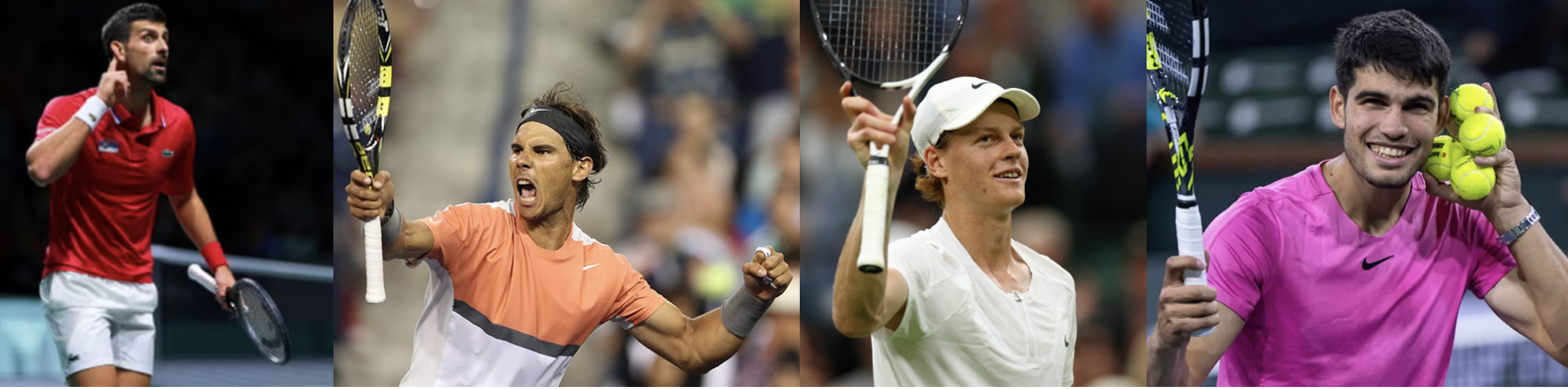

Carlos Alcaraz and Jannik Sinner, two players who have redefined modern hard-court excellence through very different approaches, have locked down a captivating duel for the 2025 tennis season. Alcaraz’s explosive versatility has proven decisive when it matters most, making him the superior hard-court performer going into Australian Open preparation. At the same time, Sinner’s methodical consistency has dominated much of the professional tour.
The statistical narrative reveals a powerful tale of contrasts. In major hard-court competitions, Alcaraz currently holds a dominant 42% return points won percentage, greatly surpassing Sinner’s 38% return efficiency. This four-percentage-point advantage might appear modest, but in elite tennis, such margins represent the difference between championship glory and runner-up disappointment. Tennis analysts and enthusiasts seeking comprehensive coverage often turn to the best betting sites for detailed statistical breakdowns that illuminate these crucial performance differentials.
The U.S. Open Revelation
The final test of hard-court dominance was the 2025 U.S. Open. At the highest level of tennis, Alcaraz’s commanding 6-2, 3-6, 6-1, 6-4 victory over defending champion Sinner demonstrated why adaptability matters more than consistency. The Spaniard’s serving development was especially devastating; he won 83% of first-serve points, hit 10 aces without making a single double-fault, and maintained 61% first-serve accuracy. Sinner, on the other hand, only converted 48% of first serves, won 48% of second-serve points, and managed just two aces with four expensive double-faults.
This discrepancy in performance goes beyond a single game. With a 7-2 head-to-head record, Alcaraz has dominated their hard-court rivalry and hasn’t lost to Sinner since 2024. Since Sinner hasn’t beaten Alcaraz on hard courts since 2023, there is no denying the psychological edge–which exacerbates tactical difficulties.
Statistical Supremacy and Tactical Evolution
The deeper statistical analysis reveals Alcaraz’s comprehensive hard-court superiority. His 30.6% unreturned serve rate over the past 52 weeks represents a massive improvement from the 25% range of previous seasons. This five-percentage-point increase in unreturned serves translates to numerous free points and shorter service games, conserving energy for crucial return games.
Alcaraz’s serve has undergone significant biomechanical refinement, with his accuracy improving from landing serves 65 centimeters from the lines in 2024 to just 61 centimeters in 2025. While maintaining his 121 mph average first-serve speed, this enhanced precision has elevated his ace production dramatically, surpassing his entire 2024 total by Wimbledon.
Sinner’s statistical profile, while impressive individually, pales in direct comparison. His 64.2% first-serve percentage and improved serve motion have enhanced his overall tour performance, but these improvements haven’t translated to success against Alcaraz specifically. The Italian’s 43% break-point conversion rate falls short of Alcaraz’s superior 50.4% efficiency, highlighting the Spaniard’s superior clutch performance.
Shanghai and the Consistency Myth
Alcaraz’s supremacy on the hard court was further demonstrated at the Shanghai Masters, although Sinner’s retirement against Tallon Griekspoor in the third round avoided a rematch. Sinner’s withdrawal put an end to his nine-match winning streak in hard-court tournament finals, raising the possibility that his renowned consistency is not as stable as previously thought.
Alcaraz’s tournament strategy exhibits exceptional flexibility in dealing with different opponents and conditions. There are more chances for quick points and psychological pressure because of his aggressive serve placement and willingness to take measured chances. This tactical adaptability is extremely helpful in the high-stress environment of major competitions, where results are frequently decided by mental toughness.
Australian Open 2026 Implications
Based on recent hard-court results, Alcaraz is the clear favorite going into the 2026 Australian Open, which will take place on Melbourne Park’s GreenSet hard courts from January 12 to February 1. He is well-positioned for success on Australia’s blue hard courts because of his ability to step up his game when it matters most, as evidenced by his championship-winning serves at the US Open.
Aggressive players who can dictate points from the baseline while maintaining serving efficiency are typically rewarded by the medium-paced surface of the Australian Open. Alcaraz can defeat any opponent, including Sinner, thanks to his improved serve and strong return numbers.
Sinner’s path to Australian Open success requires significant tactical adjustments. His team must address the serving deficiencies exposed during their US Open final defeat while developing strategies to neutralize Alcaraz’s return aggression. The Italian’s 91% service hold percentage remains impressive, but falls short of the elite level required to consistently defeat Alcaraz.
The Verdict
While Sinner’s overall consistency throughout 2025 has been remarkable, winning 110 of 120 matches since early 2024, Alcaraz’s superior head-to-head record and statistical advantages on hard courts establish him as the surface’s true king. The Spaniard’s 42% return points won versus Sinner’s 38% represents more than a statistical curiosity; it reflects fundamentally different approaches to hard-court tennis, with Alcaraz’s aggressive versatility consistently overpowering Sinner’s methodical consistency.
As both players continue their Australian Open preparation, the evidence strongly favors Alcaraz’s continued hard-court dominance. His serving evolution, return superiority, and proven ability to perform in crucial moments create a compelling case for sustained success on tennis’s fastest surfaces. Sinner remains a formidable opponent, but until he solves the Alcaraz puzzle on hard courts, the Spaniard’s versatile brilliance will continue edging Italian consistency when championships are decided.
Leave a Reply