
Favorites often lose the first set because matches start with a “feeling out” phase where they are still adjusting to the court, conditions, or the opponent’s specific pace. Underdogs usually start tennis matches with high adrenaline and swing freely with nothing to lose.
Tennis Favorites Perform Tactical Examination
Tennis favorites or top-tier players approach a match like a chess game. They use the opening games to collect real-time data on their opponents instead of relying on raw power. Some betting platforms, such as Iranshartbandi, highlight how favorites often test opponents early. A favorite usually hits balls to different areas, such as high to the backhand, short angles, or heavy slice, to see how the opponent responds.
Besides, court conditions change daily due to humidity, wind, and temperature. Favorites often play a safe, more conservative game early on to test their own timing before taking big risks. For example, Novak Djokovic famously drops the first set in early tournament rounds because he acts like an algorithm. Once he finds out where an underdog wants to serve or how they handle pressure, he breaks down his game in sets 2 and 3.
The Physical & Psychological Gap
At 0-0 in the first set, the physical and psychological gap between the world’s best and a lower-ranked player is at its absolute narrowest. The underdog’s legs are completely fresh, which allows him to chase down every ball, erase mistakes with pure hustle, and maintain a physical intensity that is impossible to sustain for 3 to 5 sets.
Underdogs enter the court with zero pressure and play with “nothing to lose,” which leads to a temporary surge in high-risk shots. These shots usually land perfectly in bounds. However, as the match progresses, the favorite’s superior cardiovascular conditioning and experience take over. The underdog’s energy decreases, his error count increases, and the true gap in skill reveals itself.
High Variance in Tennis
In other sports, such as basketball, a dominant team can absorb a bad 5 minutes because points accumulate continuously. On the other hand, tennis is divided into isolated and high-leverage segments. If a favorite drops for just 5 to 10 minutes, they might get their service game broken once. If the underdog serves well for the rest of the set, that single slip-up costs the entire set, for example, 6-4.
A set can be decided by just 2 or 3 swing points, like a net cord bounce or a missed breakpoint opportunity. A favorite can usually win more total points in a set but still lose the set itself due to poor timing on those critical points.
Moreover, winning a set takes massive effort, but it only rewards the underdog with a 1-0 lead. Once the second set starts, the score resets to 0-0, and the favorite has plenty of time to apply their adjustments and outlast the opponent.
Tennis Player Habits in Early Sets
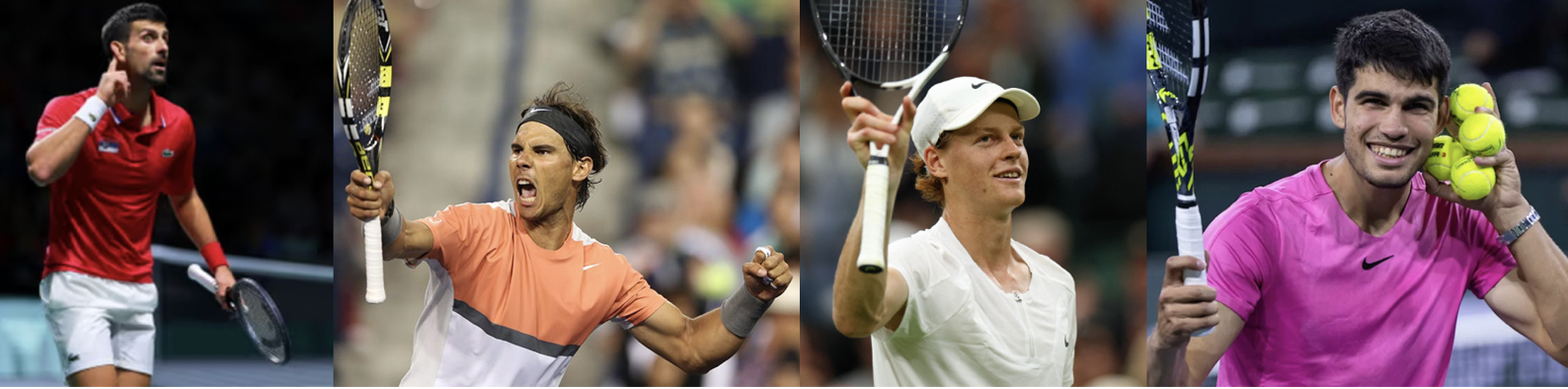
Some players have unique psychological and tactical strategies, which lead to predictable patterns in the first set. Historically, legends like Djokovic and Nadal are famous for dropping early sets against low-ranked opponents, particularly in the opening rounds of Grand Slams.
In fact, only three ATP players in open-era history have won more than 40% of their career matches after losing the first set: Novak Djokovic (the all-time leader at roughly 44%), Rafael Nadal, and Bjorn Borg. Other legends, like Roger Federer and Pete Sampras, fall closer to the 32% to 34% mark. Djokovic, Nadal, and Borg treated the first set as a physical tax, using their elite defensive skills to drain the underdog’s adrenaline and study their patterns.
On the other hand, younger and highly aggressive players tend to do the opposite. They rely on high sensory alertness and explosive footwork from the very first point. If they start slow, it is usually a sign of mental fatigue or frustration rather than a tactical calculation, which makes them more volatile if they drop the opening frame.
How Court Surfaces Impact Slow Starts
Court physics impacts whether a favorite can survive a slow start or if they will get punished for it early.
| Clay Court | Grass Court |
| High friction | Low friction |
| Long rallies | Low, skidding ball |
| Easy to break serve | Dominant serves |
| High error margin | Low error margin |
| Safe for a slow start | Dangerous for a slow start |
Clay courts offer a high margin for recovery: Clay courts feature high-surface friction, which slows the ball down and creates high bounces. Points are longer, and breaking serve is much easier. That’s why a favorite can afford a sloppy first set. The favorite has plenty of time to recalibrate their timing and physically wear down the underdog in later sets.
Grass courts have fatal unforgiveness: Grass is the fastest surface, which means the ball skids low and retains its speed. Serves are usually dominant, and rallies are very short. If a favorite starts slow on grass and drops a service game, the underdog can ride a string of unreturnable serves to win the set. There is almost no time to “test or examine” a rhythm.
Hard courts offer a neutral baseline: Hard courts have a predictable, medium-to-fast bounce. Although faster hard courts behave a bit like grass, they don’t produce the irregular, natural bad bounces of turf. Thus, this makes it slightly easier for a favorite to mount a mechanical comeback.
How Betting Markets React to a Dropped First Set
Bettors always look for the best tennis bets. But dropping a first set can impact the betting market. The live-betting market reacts aggressively when a pre-match favorite drops the opening set, which creates sharp line movements.
For instance, if a heavy pre-match favorite, let’s say priced at 1.15 or -650, loses the first set, their live odds will often skyrocket to a plus-money value, such as 2.10 or +110. Remember, this happens because the underdog is now just one set away from winning the entire match.
Another important factor is the best-of-3 vs. best-of-5 pricing. Bookmakers price comebacks based on match length. In a standard 3-set match, the favorite’s odds change because their margin for error is entirely gone. On the other hand, in a 5-set Grand Slam match, the shift is far more muted. Algorithms remain weighted toward the favorite.
Advanced sportsbooks consider player-specific tracking data. If a top-tier player has high break-point conversion rates and a history of multi-set comebacks, the market will suppress the underdog’s live value and anticipate inevitable pushback from the favorite.
Disclaimer: This article is for informational and educational purposes only. It discusses tennis strategy and betting market reactions but does not provide gambling advice. Any references to betting platforms, including affiliate links, are for illustrative purposes. Readers should gamble responsibly and check local regulations before engaging in betting activities.
Leave a Reply