
I have been watching tennis for about 20 odd years now, and the thing I still catch myself staring at, more than the rallies if I am being honest with you, is the 90 seconds where absolutely nothing happens. Player sits down. Towel over the head. Bottle, sip, bottle back down, and it has to go back down facing the right way for some of them. Then a hand goes into a bag and something small and sticky comes out and gets chewed in about four seconds flat.
That little bit. That is the bit I want to talk about.
Because for years the answer to “what is he eating” was just, well, a banana, obviously, and nobody thought about it much harder than that. That has changed alot in the last decade and the change is more interesting than it sounds.
The banana thing is mostly a myth now
There was a stretch in the nineties and the two thousands where you genuinely could not watch a Grand Slam without seeing half a banana get demolished on a changeover. It became shorthand. Tennis, sweat, and bananas. Cartoonists used it.
The problem is that a banana is a lump of solid food and solid food has to go somewhere. It sits. If you are three hours into a match in Cincinnati in August and your stomach has already given up on you because of the heat and the dehydration, that banana is not going to turn into usable energy in time to help you win the fourth set. It is going to sit there and make you feel heavy and slightly ill, which is exactly what a lot of players eventually worked out for themselves.
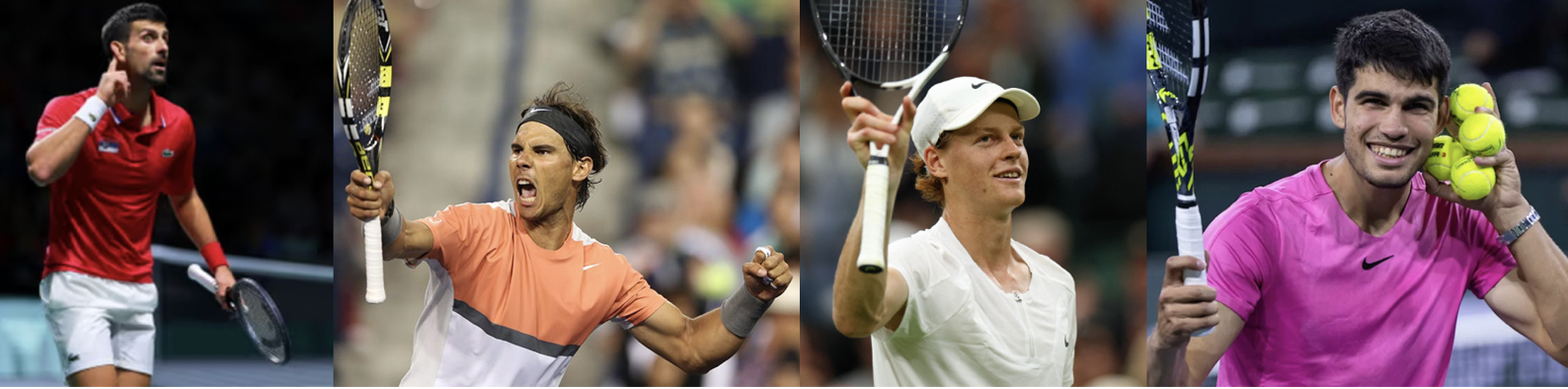
So the banana did not vanish completely. Carlos Alcaraz still gets through banana slices in long matches and he is hardly struggling for energy. But it stopped being the default. It became one option on a list instead of the whole list.
And you can see the shift on television if you know to look for it. Ten or fifteen years back the camera would cut to the bench and there would be an actual piece of fruit, peeled, half eaten, sat on the towel like somebody’s packed lunch. Now you get a hand going into a small zipped pouch and coming out with something you cannot really identify at broadcast resolution, and the commentators say nothing about it because there is nothing visual to describe anymore. The whole ritual got smaller and quieter and quite a bit more clinical, which is a shame for the cartoonists but probably good news for the players.
Why dates turned up in everybody’s bag
Novak Djokovic is the one who made this visible to a mainstream audience. He eats a piece of date on the change of ends, pretty much every time, and he has done it for years now. He has always been unusually open about what he puts in his body, and the wider dietary overhaul got written about half to death about a decade ago, but the date is the small habit that actually spread through the locker room.
The logic is not complicated once somebody explains it. A date is small, it is soft, it is basically pure quick carbohydrate, and it carries a decent amount of magnesium and iron along with it. You can chew it and swallow it in the time it takes to sit down and stand back up. It does not sit in your gut arguing with you. And two of them will give you a similar hit to a much larger, much heavier snack.
Once Djokovic did it and kept winning, half the locker room had dates in their kit bag within about two seasons. That is just how sport works. Nobody is running controlled trials in the players’ lounge, they are watching the guy who wins and copying him, and to be fair to them, in this case the guy who wins happened to be right.
Gels, chews, and the ninety minute cliff
Then there is the other category, the sachets. Isotonic gels, sports chews, the little foil packets that look like something you would use to repair a bicycle. Not glamorous. Very effective though.
The thing gels are actually solving is a timing problem, not a hunger problem. Your body stores a limited amount of usable fuel in the muscles and the liver as glycogen, and once you have burned through a decent chunk of that, you do not get gradually tired in a nice linear way. You fall off a cliff. Anyone who has played a long third set knows the feeling, one game you are fine and moving and the next one your legs have been swapped out for somebody else’s legs and you cannot work out when it happened.
Roughly speaking that cliff lives somewhere around the ninety minute mark for a lot of people, though it moves around depending on the person and the conditions and how well they ate the night before. The whole point of taking on small amounts of quick sugar every single changeover, rather than one big top up when you start feeling rough, is that you never actually reach the edge. You keep topping the tank up before the light comes on. Definitely less dramatic than it looks on TV, where it just looks like a bloke eating sweets.
The crash that commentators never mention
Here is the part that gets skipped in coverage, and it is the interesting part.
If you take on a big hit of fast sugar and then do not immediately go and work, your body responds by dumping insulin, and you end up lower than where you started. That is the crash. It is real and it is horrible and it is why a normal person eating a chocolate bar at their desk feels great for eleven minutes and then wants to lie down under it.
Players mostly dodge this because they are about to sprint again in ninety seconds, so the sugar gets used more or less on arrival. The window works in their favour. But get the timing wrong, take a big gel at 4-4 in a set that then ends quickly, sit through a long medical timeout or a rain interruption, and suddenly you are the person on the desk with the chocolate bar. In a Grand Slam fourth round. On camera.
Which is a genuinely awful thing to imagine, and it is one of the quiet reasons the nutrition staff care so much about the small and often approach rather than the big rescue snack.
The fluid side of it runs on exactly the same logic, by the way, and it is arguably the more important half. Drink at every changeover, not just the ones where you feel thirsty, because by the time you actually feel thirsty on a hot court you are already behind and playing catch up for the rest of the afternoon. Most of the bottles you see lined up on the bench are not plain water either. There will be an electrolyte mix in at least one of them, salt and potassium and the rest, since a player can sweat out a genuinely silly volume over four sets and putting plain water back in on its own leaves you sloshing about with the wrong balance of things. That is why you see two or three different coloured bottles going in and out of rotation and why some of them get guarded so carefully. Every single one of them has a specific job.
Small and often, then. That is the whole philosophy in three words, and it applies to the sugar and the salt and the water in exactly the same way.
Sweets, screens, and the dead air problem
None of this is confined to the court, mind you. Anybody who has sat in the stands through a two hour rain delay, or watched a night session that dragged until nearly two in the morning, knows that the crowd has exactly the same problem in a much less athletic form. Long stretches of nothing, and a strong urge to eat something sugary and look at a phone.
The sweets industry has understood this for a very long time and so, apparently, has the games industry, because there is an entire category of casual titles built out of confectionery imagery for precisely these gaps. Candyland Casino game at Vegas Mobile Casino is a fairly typical example of the genre, a 1×2 Gaming slot laid out across five reels and nine paylines with strawberries and lemon drops and cola bottles instead of the usual fruit set, running a 96.00% RTP, with a free spins round and a Haribonus feature sitting on top of it. It is not pretending to be anything other than a bright, sugary way to fill twenty minutes of dead air, which is honestly a more honest pitch than most things get. Worth knowing that the sugar on screen has the same job as the sugar in the bag, roughly speaking. It keeps you interested until play restarts.
And underneath all that there is a business layer nobody in the stands ever thinks about, which I find quite interesting in its own right. Every one of those bright little games reaches your phone through somebody’s partnership deal, this site very much included if you have ever scrolled down as far as the footer, and the operators running those programmes are definitely not doing the sums on a spreadsheet at the end of the month. They run dedicated casino affiliate software to track where a click actually came from, work out which partner earned which commission, and screen out the junk traffic that turns up the second there is real money sat on the table. Deeply unglamorous plumbing, all of it. But it is the reason the whole rain delay economy functions at all, and it is basically why the advertising you get served during a two hour interruption is aimed at you so specifically.
What the physios will actually tell you
Now, the honest bit, because I do not want to oversell any of this.
If you sit a tennis physio down and ask them how much of a match is decided by changeover snacks, they will look at you like you have asked something slightly stupid, and they will be right to. The answer is not very much. Matches are decided by serving, by movement, by whether somebody’s backhand holds up under pressure at 5-5. Nutrition is a hygiene factor. Get it badly wrong and it will absolutely cost you a match, but get it perfect and you have not gained anything special, you have simply avoided losing something.
The other thing they will tell you, and this is the bit recreational players ignore every weekend without fail, is that almost none of this applies to a sixty minute club match. If you are playing for an hour on a Tuesday evening you have not gone anywhere near your glycogen stores and you do not need a gel. You need water. That is it. Copying a professional’s five hour fueling protocol for a short social match is a separate mistake entirely, and a fairly common one, and mostly it just means you have eaten a load of sugar you did not need.
So, useful, but not magic. Fair is fair.
The 2026 heat rule changed the sums a bit
One last wrinkle, and it is a recent one. From this season the ATP has brought in a proper [extreme heat rule](https://www.atptour.com/en/news/new-heat-rule-effective-from-2026) that lines up with what the WTA has been running, after seven players retired mid match in the conditions at Shanghai in 2025.
It works off Wet Bulb Globe Temperature, which bundles humidity and wind and sun angle in with the raw air temperature rather than just reading a thermometer and hoping. Once WBGT hits 30.1°C or above in the first two sets of a best of three, a ten minute cooling break after the second set becomes available on request, and either player can ask for it. Push past 32.2°C and play gets suspended altogether until it is safe again.
Ten minutes is a long time in this context. It changes the fueling question completely, because now you have a proper window where you can shower, change, take on fluid, get coached, and eat something that would have been far too slow to be of any use in a ninety second sit down. Watch for it this summer, especially in Asia and in the American hard court swing. The bags are going to start carrying two kinds of food, the fast stuff for the changeovers and something slightly more substantial for the break that might never come.
Small thing. But it is the sort of small thing that quietly decides a fifth set.
Leave a Reply