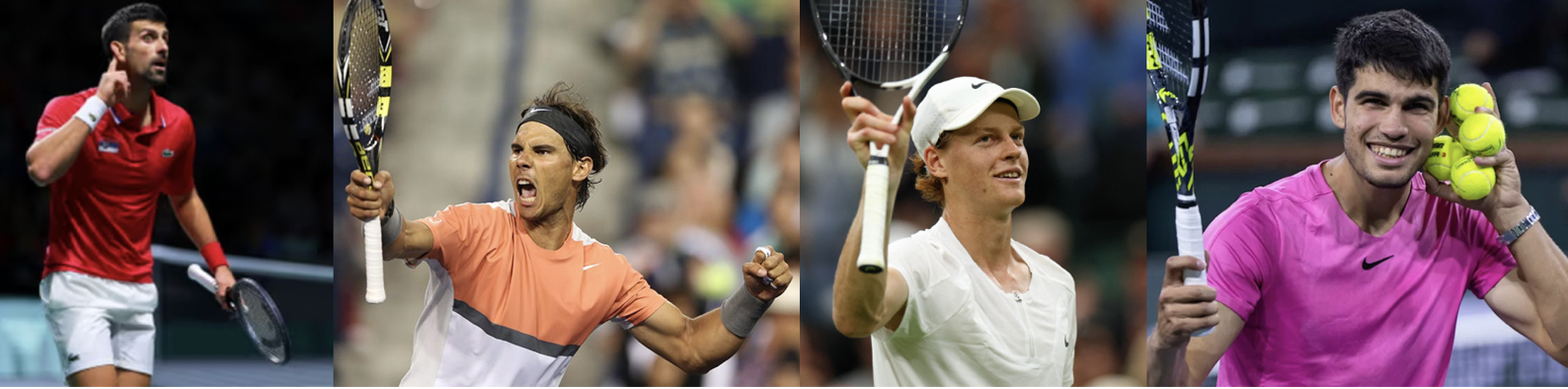

The April 2026 ATP ranking update returned Jannik Sinner to the summit. It added another chapter to his rivalry with Carlos Alcaraz, whose speed and all-court creativity have transformed elite tennis. Rankings change weekly, however, so the official ATP list should always be checked for the latest position.
Sinner’s ranking makes him the statistical answer, but not the permanent verdict. Lorenzo Musetti and other emerging contenders can shift the balance as the tour moves between clay, grass, and hard courts. Mega Casino reflects this uncertainty through tennis odds that respond to changes in form, fitness, and playing conditions.
Men’s tennis has entered a defining generational transition. Carlos Alcaraz and Jannik Sinner now lead many major events, while Novak Djokovic continues to connect the current tour with its most successful era. Behind them, established contenders and emerging talents make the ATP field unusually diverse.
Identifying the best player is not simply a matter of checking one ranking. Weekly positions measure recent performance, while greatness develops across entire careers. Grand Slam titles, versatility, longevity, and influence all matter.
Who Is the Best Male Tennis Player in the World?
Based on the ranking snapshot supplied for this article, Sinner is the men’s World No. 1. The ATP system measures results over a rolling 52-week period. Players gain points at Grand Slams, Masters 1000 events, and other eligible tournaments.
That system rewards consistency rather than reputation. Andrey Rublev, for example, can remain near the leading group through strong weekly results even without winning a major. The rankings do not decide who owns the greatest career.
How the ATP Rankings Define World No. 1
Points normally remain on a player’s record for 52 weeks. They then expire unless the player earns replacement points. Alexander Zverev can therefore gain or lose ground even when his current form appears unchanged.
Tournament category also matters. A Grand Slam champion receives 2,000 ranking points, while a Masters 1000 winner earns 1,000. Lower-level ATP events offer fewer points but can still determine important ranking positions.
Ranking Leader Versus Greatest Player
A current No. 1 has produced the strongest ranking record during the relevant period. Historical greatness requires a broader assessment. Andy Murray demonstrated the difference by reaching No. 1 after years of competing against three record-setting champions.
Useful comparison criteria include:
- Current ranking and points earned during the previous 52 weeks.
- Grand Slam titles, finals, and consistency across several seasons.
- Results on hard courts, clay, grass, and indoor surfaces.
- Head-to-head records against other leading players.
- Longevity, injury recovery, and influence beyond match results.
A ranking is objective within its rules. It cannot fully measure an athlete’s cultural influence, peak level, or ability to dominate one particular surface.
ATP Stars and the Careers Behind Their Rankings
The leading men’s tour includes established champions and developing contenders. Jack Draper represents a younger generation with the power to challenge on faster courts, while several experienced players continue adapting their games.
Jannik Sinner
Born in northern Italy in 2001, Sinner was an accomplished junior skier before prioritising tennis. His compact groundstrokes and early ball contact support an aggressive baseline game. Grand Slam success established him as a generational leader, while improved serving and movement accelerated his rise.
Like other professionals, Sinner receives no fixed ATP salary. His income combines prize money, endorsements, and bonuses. His contribution is especially visible in Italy, where his results have helped expand national interest in tennis.
Carlos Alcaraz
Born in Murcia in 2003, the Spaniard developed under former world No. 1 Juan Carlos Ferrero. He became the youngest ATP No. 1 in men’s ranking history after winning the 2022 US Open.
His drop shots, explosive movement, and forehand make him effective across surfaces. Major victories on hard courts, grass, and clay confirmed that versatility. Tournament winnings form only one part of his income, as global sponsorships have also followed his early success.
Novak Djokovic
The Serbian champion developed from a defensively gifted junior into one of the sport’s most complete competitors. His return of serve, flexibility, and control under pressure produced record-level achievements across every major surface.
The phrase Djokovic Wimbledon reflects one of tennis history’s defining relationships. His Centre Court victories combined precise returning with exceptional grass-court movement. Career prize money exceeding USD 180 million by 2024 also demonstrated his extraordinary competitive longevity.
Alexander Zverev
Born in Hamburg in 1997, the German entered the professional game with a powerful serve and two-handed backhand. He won the 2018 ATP Finals and Olympic singles gold in Tokyo.
A severe ankle injury during the 2022 Roland-Garros semifinal interrupted his progress. His return to the top level became another significant career achievement. He has earned tens of millions in official prize money, though travel, coaching, and tax costs reduce the amount retained.
Lorenzo Musetti
The Italian was born in Carrara in 2002 and won the 2019 Australian Open boys’ title. His one-handed backhand and varied shot selection distinguish him from many modern baseline players.
Strong clay-court foundations helped his early development. Later grass-court results showed a wider competitive range.
Andrey Rublev
Born in Moscow in 1997, Rublev won the 2014 Roland-Garros junior title. His professional game is built around forceful forehands, early court positioning, and sustained baseline pressure.
Masters 1000 success strengthened his position among the tour’s most consistent players. He has also spoken openly about emotional pressure in professional sport. That honesty contributes to wider discussions about athlete welfare.
Jack Draper
Draper was born in London in 2001 and grew through Britain’s national development system. A left-handed serve and heavy forehand give him clear advantages on hard courts and grass.
His development has depended on balancing physical intensity with injury prevention. Improved endurance and scheduling enabled deeper runs at major events.
Cameron Norrie
Norrie was born in South Africa, grew up in New Zealand, and represents Great Britain. College tennis at Texas Christian University provided an important stage in his development.
His flat backhand and heavier forehand create an unusual rhythm for opponents. A breakthrough Masters title and a Wimbledon semifinal established his top-level credentials. He has also highlighted college tennis as a viable route into the professional game.
Matteo Berrettini
Born in Rome in 1996, Berrettini became one of Italy’s leading grass-court players. His serve and forehand drive an attacking style designed to shorten points.
He reached the 2021 Wimbledon final and helped demonstrate Italy’s growing depth. Repeated injuries later disrupted his ranking momentum. His subsequent returns showed the physical and financial cost of rebuilding a professional career.
Alexander Bublik
Born in Russia in 1997, Bublik has represented Kazakhstan during his senior career. His game features a powerful serve, underarm deliveries, drop shots, and frequent changes of pace.
The unpredictability associated with Bublik tennis can trouble structured opponents, but it also carries risk. Tournament titles proved that his creativity can produce sustained results. His distinctive approach broadens ideas about acceptable tactics in elite competition.
Felix Auger-Aliassime
The Canadian was born in Montreal in 2000 and recorded early Challenger-level success. Felix Auger developed a powerful serve and first-strike game, then improved his patience during longer exchanges.
He also contributed to Canada’s team success. His career illustrates how an early breakthrough does not remove the need for technical adjustments.
Grigor Dimitrov
Born in Bulgaria in 1991, Dimitrov became junior champion at Wimbledon and the US Open. His fluid movement and one-handed backhand encouraged early comparisons with past champions.
The 2017 ATP Finals title marked his strongest complete season. Searches for Dimitrov tennis often focus on technique, but longevity is equally important. Adjustments to positioning and shot selection helped him remain competitive against younger opponents.
Roger Federer
The Swiss champion developed from an emotional junior into a model of controlled attacking tennis. Roger Federer won 20 Grand Slam singles titles and spent 310 weeks at No. 1.
His movement, serve, and willingness to approach the net shaped modern all-court play. He earned about USD 130.6 million in official career prize money, while endorsements produced much larger commercial income. His influence also expanded tennis audiences worldwide.
Andy Murray
Born in Glasgow in 1987, Murray emerged during an exceptionally competitive era. He won three Grand Slam singles titles, two Olympic singles gold medals, and led Britain to the 2015 Davis Cup title.
Hip resurfacing surgery threatened his career, yet he returned to tour competition. His defensive anticipation and tactical intelligence influenced younger players. Official prize money exceeded USD 64 million, excluding sponsorship and expenses.
Conor Niland
Niland was born in Birmingham in 1981 and represented Ireland. He competed at Wimbledon and the US Open while spending much of his career outside the sport’s wealthiest tier.
His experience reveals the economic gap between leading stars and lower-ranked professionals. Travel, coaching, and accommodation can consume earnings before taxes. His later writing added an important player-level perspective to discussions about tour economics.
How Professional Tennis Players Earn Money
Professional players are independent contractors rather than salaried ATP employees. Their finances usually involve:
- Prize money earned according to progression through each tournament.
- Sponsorship payments, performance bonuses, and equipment agreements.
- Appearance fees at selected events where regulations permit them.
- Coaching, fitness, medical, accommodation, and international travel costs.
- Taxes, agent commissions, insurance, and pension arrangements.
Five Defining Events on the Global Tennis Calendar
The biggest tennis tournaments test different physical and technical skills. Grand Slams use best-of-five-set matches in the men’s competition, creating demands rarely found elsewhere on tour.
Five Tournaments and Performances That Shaped Tennis History
| Rank | Tournament | Surface | Featured performance | Why it mattered |
| 1 | Wimbledon | Grass | Federer’s eight men’s singles titles | He established the Open-era men’s record at the event |
| 2 | Australian Open | Hard | Djokovic’s record run of titles | His returning and movement redefined hard-court consistency |
| 3 | Roland-Garros | Clay | Alcaraz’s 2024 title | He became the youngest man to win majors on three surfaces |
| 4 | US Open | Hard | Sinner’s 2024 championship | The victory strengthened his position at the top of the sport |
| 5 | ATP Finals | Indoor hard | Zverev’s titles in 2018 and 2021 | He defeated elite fields under contrasting competitive conditions |
Wimbledon 2019: Novak Djokovic Versus Roger Federer
The 2019 Wimbledon final lasted four hours and 57 minutes. It became the longest men’s singles final in the tournament’s history. The match also produced one of Centre Court’s most painful reversals.
Federer played with attacking precision. He won more total points, struck more winners, and repeatedly placed pressure on the Djokovic serve. The Swiss champion appeared to take control when he broke for an 8–7 lead in the deciding set.
Serving at 40–15, Federer held two championship points. A ninth Wimbledon title was one successful serve or decisive forehand away. Djokovic saved both chances and broke back, refusing to let the atmosphere or scoreboard change his disciplined patterns.
The final eventually reached 12–12. Under the rules used that year, Wimbledon then staged its first deciding-set singles tiebreak. Djokovic won it 7–3 without losing focus on the most important points.
The Djokovic Wimbledon relationship is often explained through titles. This match revealed something deeper. Djokovic could absorb an opponent’s best tennis, survive a largely partisan crowd, and remain precise when a single error might decide the championship.
Australian Open 2024: Jannik Sinner Versus Daniil Medvedev
Sinner entered his first major final after defeating Djokovic in the semifinals. Yet Medvedev initially made the occasion look overwhelming. The Russian stood closer to the baseline than usual and attacked before Sinner could establish his rhythm.
Medvedev won the first two sets 6–3, 6–3. His returning was aggressive, while his flatter groundstrokes denied Sinner time. The Italian faced a choice between forcing riskier shots and accepting the patterns dictated by his opponent.
Instead, Sinner adjusted gradually. He extended rallies, served with greater accuracy, and made Medvedev cover more ground. The effect became visible as the Russian’s demanding tournament began to catch up with him.
Sinner captured the third and fourth sets 6–4. By the deciding set, his earlier tension had disappeared. A forehand winner sealed the final 6–3 and completed a comeback from two sets behind.
The victory gave Sinner his first Grand Slam title. More importantly, it showed that his development was not limited to cleaner ball-striking. He had learned to solve tactical problems while managing the emotional weight of a major final.
Roland-Garros 2024: Carlos Alcaraz Versus Alexander Zverev
The 2024 Roland-Garros final moved through several dramatic changes of control. Alcaraz took the opening set, but Zverev responded by using his serve and backhand to dictate the middle stages.
Alcaraz led 5–2 in the third set before losing five consecutive games. Zverev moved ahead by two sets to one, leaving the Spaniard without room for another poor sequence.
Rather than chasing spectacular winners, Alcaraz simplified his approach. He increased the height of his groundstrokes, defended with greater patience, and used drop shots more selectively. Zverev’s first-serve effectiveness declined as the match became increasingly physical.
Alcaraz dominated the fourth set 6–1 and secured two early breaks in the fifth. He saved every break point he faced during the deciding set, then completed the victory after four hours and 19 minutes.
The title carried historic weight. At 21, Alcaraz became the youngest man to win Grand Slam singles championships on hard courts, grass, and clay. For Zverev, the defeat illustrated the narrow margins of major finals. He had controlled important stretches but could not stop his opponent’s final tactical adjustment.
US Open 2022: Carlos Alcaraz Versus Casper Ruud
The 2022 US Open final offered two rewards. The winner would claim his first Grand Slam title and become the new world No. 1.
Alcaraz arrived after three consecutive five-set victories. His route through the previous rounds had required more than 13 hours on court, including a quarterfinal against Sinner that ended at 2:50 a.m. Fatigue should have favored the more rested Ruud.
The Spaniard nevertheless opened with fearless movement and aggressive returning. Ruud answered in the second set, using greater consistency to slow the match. The third set became decisive.
At 5–6, Alcaraz saved two set points at the net. He then overwhelmed Ruud in the tiebreak, winning it 7–1. That sequence changed the emotional balance of the final.
Alcaraz completed the fourth set with an ace. At 19 years old, he became the youngest men’s world No. 1 since the ATP rankings began in 1973. The match announced more than a new champion. It revealed a player capable of maintaining courage and creativity after an exhausting two-week campaign.
ATP Finals 2018: Alexander Zverev Versus Novak Djokovic
Zverev entered the 2018 ATP Finals championship match as a talented contender rather than an established major force. Djokovic had defeated him comfortably during the group stage and appeared to hold every psychological advantage.
The final produced a different contest. Zverev served with authority and resisted the temptation to overplay from the baseline. His backhand remained stable against Djokovic’s depth, while his court position prevented the Serbian from controlling every neutral exchange.
A break late in the opening set gave Zverev a 6–4 advantage. He then broke immediately in the second set, placing Djokovic under sustained scoreboard pressure. Even when victory approached, the German continued committing to full swings.
Zverev won 6–4, 6–3 to claim the most important title of his young career. He had defeated Federer in the semifinal and Djokovic in the final, overcoming two champions who had shaped the previous decad
When Tennis Favorites Defy the Odds
Tennis odds reflect form, surface, fitness, previous meetings, and market expectations. Lower numbers indicate favorites, while higher prices identify outsiders. However, reputation cannot determine the result.
The 2023 Wimbledon final offered a clear example. Novak Djokovic started near 1.45 to 1.50 with many bookmakers, while Carlos Alcaraz was priced around 2.70 to 2.85. Djokovic won the opening set 6–1, but Alcaraz adjusted his tactics and completed a five-set victory after four hours and 42 minutes.
Another reversal came in the 2024 Australian Open final. Daniil Medvedev led Jannik Sinner by two sets before the Italian extended the rallies and took control. Such shifts explain the popularity of live tennis betting, where prices can change after a service break or demanding set.
Emma Raducanu delivered an even greater surprise at the 2021 US Open. Some bookmakers reportedly offered her at around 400-to-1 before the tournament. She advanced through qualifying and won ten matches without losing a set, becoming the first qualifier to claim a Grand Slam singles title.
Reliable tennis predictions require more than rankings. Important factors include:
- Results on the tournament’s surface.
- Tactical compatibility between the players.
- Recovery time after previous matches.
- Current serving and returning form.
- Confirmed fitness or injury information.
Readers familiar with World Cup predictions will recognize tournament-winner markets. However, World Cup odds depend on squads and knockout routes, while tennis prices focus on one athlete’s condition, opponent, and preferred surface.
Odds provide useful context for historic upsets. Responsible gambling means setting limits, never chasing losses, and only wagering money you can afford to lose.
FAQ
Who is the current men’s World No. 1?
The ranking snapshot supplied for this article places Jannik Sinner at No. 1 following an April 2026 return to the summit. Because ATP standings update weekly, readers should confirm the latest official table.
Is the ATP No. 1 automatically the greatest player?
No. The ranking identifies the strongest 52-week points record. Historical greatness also involves major titles, longevity, peak performance, competition, and influence on the sport.
Which are the four Grand Slam tournaments?
They are the Australian Open, Roland-Garros, Wimbledon, and the US Open. Together, they cover hard courts, clay, and grass.
Do professional tennis players receive a salary?
Most do not receive a fixed salary. They earn prize money and commercial income while paying their own professional expenses. Lower-ranked players can therefore face financial losses despite competing internationally.
What should readers check before making a tennis prediction?
Review the surface, recent form, injury information, workload, match format, and tactical matchup. Past results provide context, not certainty, and responsible gambling limits remain essential.
Leave a Reply