
At Grand Slam level, the physical and technical gap between the top 50 players in the world is smaller than most people think. What separates the players who win tight five-set matches from those who lose them is almost never technique. It’s the tennis mental game.
This is true at every level of the sport — from Wimbledon Centre Court to your local club’s Saturday league. The player who manages their mind better under pressure wins more matches. Here’s what the best Grand Slam players do differently — and how you can apply the same principles to your own game.
1. They Play One Point at a Time — Not One Match at a Time
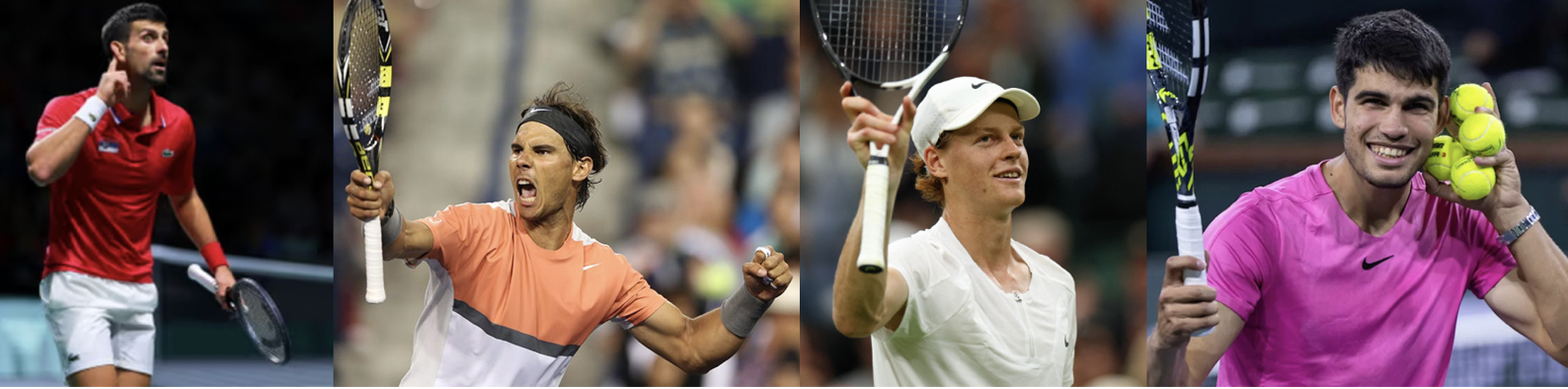
Watch Novak Djokovic between points. After every single point — won or lost — he goes through the same routine. He turns away from the net, adjusts his strings, takes a breath, and resets. By the time the next point starts, the previous one is gone.
This is not a personality trait. It’s a trained skill.
Most club players do the opposite. They carry the last point into the next one. A double fault becomes two double faults. A missed forehand becomes a pattern of missed forehands. One bad game becomes a lost set.
The best Grand Slam players have learned to treat every point as a separate event. The score is irrelevant. The last point is irrelevant. The only thing that exists is the next ball.
How to apply it: Develop a between-point routine and use it after every single point — not just bad ones. Five seconds: turn away from the net, one breath, one word (“next” or “reset”), bounce on your toes. The consistency of the routine is what makes it work.
2. They Reframe Pressure as Privilege
In a 2019 Wimbledon semifinal interview, Roger Federer was asked how he handles the pressure of playing on Centre Court in front of 15,000 people. His answer was simple: “I love it. This is what I’ve worked for.”
Elite players don’t experience pressure the same way average players do — not because they feel less of it, but because they’ve learned to interpret it differently. Pressure means the match matters. It means you’re in a situation worth being in.
The physiological response to excitement and the physiological response to anxiety are almost identical — elevated heart rate, heightened alertness, increased adrenaline. The difference is the story you tell yourself about what those sensations mean.
How to apply it: When you feel nervous before a big match or a crucial point, reframe it consciously. Instead of “I’m nervous,” say “I’m ready.” The physical sensation is the same. The mental interpretation changes everything.
3. They Have a Clear Game Plan — and Stick to It Under Pressure
One of the most common mistakes at club level is abandoning a game plan the moment it stops working immediately. A player decides to attack the opponent’s backhand, hits two forehands to the forehand instead, and concludes “the plan isn’t working.”
Grand Slam players commit to their game plan for entire sets — sometimes entire matches — before adjusting. They understand that a tactic needs time to work. An opponent’s backhand doesn’t break down on the first ball. It breaks down on the fifteenth.
Rafael Nadal’s game plan on clay is almost always the same: heavy topspin to the opponent’s backhand, pull them wide, attack the open court. He executes this plan thousands of times per match. The repetition is the point.
How to apply it: Before every match, identify one tactical priority — attack the backhand, serve wide on the deuce side, come to the net on short balls. Commit to it for at least one full set before evaluating whether to adjust.
4. They Manage Energy, Not Just Effort
Five-set Grand Slam matches last three to five hours. Players who go full intensity from the first point often fade in the fourth and fifth sets. The best players manage their energy like a resource — conserving it when possible, spending it when it counts.
This shows up in how they walk between points (deliberately slow), how they use the 90-second changeover (sitting, breathing, not thinking about tennis), and how they choose when to go for winners versus when to reset with a safe ball.
How to apply it: In long matches, consciously slow down between points. Walk to the baseline slowly. Use the full time allowed between games. Save your maximum intensity for the points that matter most — break points, set points, and the opening game of each set.
5. They Accept Errors Without Judgment
Every Grand Slam champion makes unforced errors. Djokovic makes them. Alcaraz makes them. Swiatek makes them. The difference is what happens in the five seconds after the error.
Average players judge themselves. “I always miss that shot.” “I’m terrible under pressure.” “Why do I keep doing this?” This internal commentary occupies mental bandwidth that should be focused on the next point.
Elite players acknowledge the error and move on. Not because they don’t care — but because they’ve learned that self-criticism during a match is functionally useless. There’s nothing you can do about the last point. There’s everything you can do about the next one.
How to apply it: After an error, allow yourself one second of acknowledgment — a brief exhale, a shake of the head — then physically reset. The between-point routine is your tool for cutting off the self-critical spiral before it starts.
The Mental Game Is a Skill, Not a Personality Trait
The most important thing to understand about the tennis mental game is that it’s trainable. Djokovic wasn’t born with the ability to stay calm at 5-5 in the fifth set of a Grand Slam final. He developed it through years of deliberate practice, coaching, and mental training.
You can develop it too — at any level. For a complete guide to building mental toughness on the tennis court, the Mastering Your Tennis Mindset guide from Tennis Mindset covers focus, confidence, pressure management, and between-point routines in detail.
Summary: The Grand Slam Mental Game in 5 Principles
- ✅ One point at a time — develop a between-point routine and use it every point
- ✅ Reframe pressure — “I’m nervous” becomes “I’m ready”
- ✅ Commit to your game plan — give tactics time to work before adjusting
- ✅ Manage energy — slow down between points, save intensity for what matters
- ✅ Accept errors without judgment — acknowledge and move on, every time
The mental game doesn’t require talent. It requires practice. Start with one principle per match and build from there.
For more tennis mindset and training content, visit Tennis Mindset — free guides for players at every level.
Leave a Reply