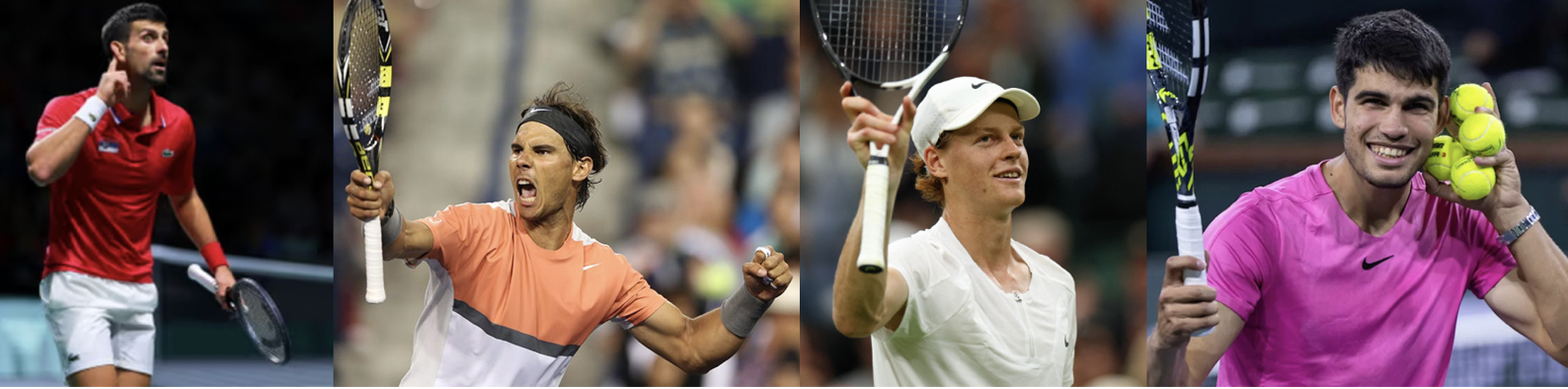

Carlos Alcaraz headed into the 2026 Australian Open having won everything else. Three Wimbledons, two US Opens, a French Open defended and redefended — the one major that kept refusing him was Melbourne, where his game seemed to arrive a beat too early or too late every January. On February 1, that stopped mattering. After losing the first set 2-6 to veteran GOAT Novak Djokovic, the Spanish prodigy simply refused to let the match settle into a shape his Serbian adversary liked, ripping off three sets in a row to close it out 2-6, 6-2, 6-3, 7-5.
Twenty-two years, eight months, and 27 days old, and he’d completed the career Grand Slam faster than anyone in the sport’s history. And at that very moment, it looked as though 2026 would belong to the young Spaniard, but fate had other ideas. Alcaraz injured his right wrist in the opening round of April’s Barcelona Open, and he hasn’t played a single game since. Suddenly, the door was ajar for Jannik Sinner to rack up the titles with his biggest rival sidelined for the foreseeable future.
Alcaraz’s Injury Opens the Door
Paris was supposed to belong to the Italian. He headed to the French capital as the undisputed form player on the planet in Alcaraz’s absence, the obvious favorite the moment the draw came out. Then, he collapsed in dramatic fashion, surrendering a two-set lead in the second round to Juan Manuel Cerúndolo to suffer one of Roland Garros’ greatest ever upsets. Alexander Zverev, tennis’s most talented nearly-man for years running, walked through the wreckage and picked up his first Grand Slam title at long last.
Sinner answered the only way that mattered. Wimbledon: He knocked off Djokovic in straight sets in the semifinals before downing a Zverev determined to reel off two straight Slams, rallying back from one set down to win 6-7(7), 7-6(2), 6-3, 6-4 and successfully defend his All-England Club throne.
Now, with the US Open lurking on the horizon, the ATP Tour finds itself on the precipice of history. It has been 12 long years since the tour saw four different men win the available Slams in the same calendar year, and should anyone other than Sinner, Alcaraz, and Zverev reign supreme at Flushing Meadows, that streak will come to an end. But truth be told, online betting sites think it’s unlikely. The latest odds from 5Gringos online sportsbook currently make those three superstars the three most likely winners in the Big Apple, with 11/1 shot Djokovic considered the biggest threat from the rest of the field.
It remains to be seen whether that 12-year run will come to an end, but who were the superstars dominating the tour the last three times we had four different slam winners in a calendar year? Let’s take a look.
2014
Stan Wawrinka wasn’t supposed to be there. By January 2014, he was a fine player, a proven top-tenner, but a career journeyman next to Djokovic and Nadal — the guy who lost the tight ones. Then he beat Djokovic in the Australian Open quarterfinals, snapping the Serb’s 25-match Melbourne winning streak that had felt unbreakable, and somehow that wasn’t even the final. Nadal, restored to No. 1 and chasing his own double career Slam, needed treatment for a back injury that turned the final into theater as much as tennis. Wawrinka closed it out 6–3, 6–2, 3–6, 6–3, the first man to beat the top two seeds at a major since 1993.
Nadal answered on his own turf, grinding out a 3–6, 7–5, 6–2, 6–4 win over Djokovic for a ninth French Open. Then Wimbledon delivered a final for the ages — Djokovic and Federer trading blows for nearly four hours; Djokovic finally prevailing 6-7(7), 6-4, 7-6(4), 5-7, 6-4, the only time in Federer’s career he’s lost a Wimbledon final after winning the first set. Somewhere down in the fourth round, wildcard Nick Kyrgios had already bounced world No. 1 Nadal off Centre Court, the kind of result that makes you check the scoreboard twice.
The Big Apple then handed the sport something almost nobody saw coming: Kei Nishikori and Marin Čilić both making the final, which guaranteed a first-time champion once Federer and Djokovic fell in the semis. Čilić, a year removed from a doping ban that cost him the previous US Open entirely, simply blew Nishikori off the court, 6–3, 6–3, 6–3.
2012
Five hours and 53 minutes. That’s how long Djokovic and Nadal needed in the Melbourne heat to settle the longest Grand Slam final in history, 5–7, 6–4, 6–2, 6–7(5–7), 7–5, two men who’d already played each other more than 30 times somehow finding new ways to hurt one another. Roland Garros brought its own drama a few months later — Djokovic found himself two sets down before rain suspended the final overnight, the first time that had happened since 1973. Nole clawed one of those sets back before Nadal came back and closed it out 6-4, 6-3, 2-6, 7-5, passing Björn Borg for the most French Open titles ever won.
Then came Wimbledon, and Andy Murray’s first shot at ending 76 years of British hurt. He lost to Federer 4–6, 7–5, 6–3, 6–4, and cried on Centre Court doing it. Weeks later, at Flushing Meadows, he didn’t blink, outlasting defending champion Djokovic 7–6(12–10), 7–5, 2–6, 3–6, 6–2 to become the first British man to win a major since Fred Perry in 1936.
2003
Andre Agassi was 32, tennis’s elder statesman, and Melbourne kept being kind to him anyway — 6–2, 6–2, 6–1 over Rainer Schüttler made him the oldest men’s Slam champion since 1972. But 2003 wasn’t really about him. It was about a 21-year-old Roger Federer walking into the Wimbledon semifinals against Andy Roddick — a match that should’ve been a coin flip — and simply taking it apart. Nobody in that press room quite knew what they were watching yet, but Federer’s 7–6(7–5), 6–2, 7–6(7–3) win over Mark Philippoussis in the final was the first of a record eight Wimbledon titles.
In between, Juan Carlos Ferrero finally cashed in his talent at Roland Garros, routing Martin Verkerk 6–1, 6–3, 6–2. And Flushing Meadows closed the loop on a genuine changing of the guard — Andy Roddick was two sets down against David Nalbandian before saving match points and pulling off the comeback of all comebacks, then beating Ferrero 6–3, 7–6(7–2), 6–3 in the final. 23 years on, he remains America’s most recent men’s Slam champion.
Leave a Reply