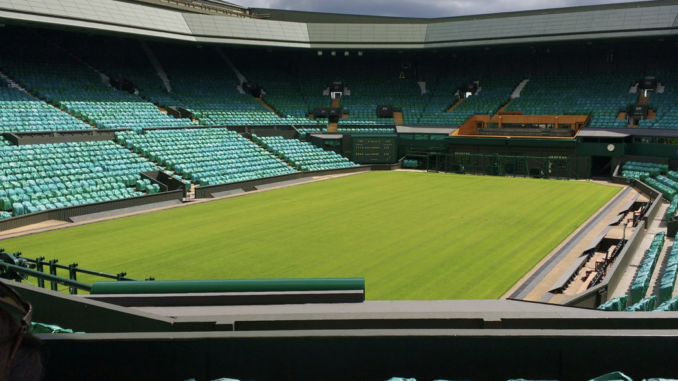
Jannik Sinner lifted the Wimbledon trophy on Sunday for the second consecutive year, and the manner of the victory over Alexander Zverev tells an interesting story beyond the scoreline. He dropped the first set in a tiebreak, lost the first three games of the second before engineering a comeback, and then methodically closed out the match over the final two sets in a way that made it look significantly more comfortable than the opening hour had suggested it would be. Zverev had just won the French Open on clay a month earlier, had reached consecutive Grand Slam finals, and came into the fortnight as a genuine co-favorite. Sinner beat him in four sets.
What the Wimbledon result confirmed, and what the broader pattern of this calendar year underscores, is that Sinner’s dominance at the All-England Club is not simply about his game on grass. It is about his physical state when he arrives at Wimbledon. Neither he nor Novak Djokovic made it to the fourth round at Roland Garros this year, a result that looked alarming at the time and reads differently now. Sinner arrived at Wimbledon with three weeks of recovery and specific preparation between his Roland Garros exit and the start of the fortnight. The physical condition he brought to the All-England Club, and the way he managed that condition across seven matches and the better part of two weeks, is as much the story of the back-to-back titles as anything that happened on the court.
The Physical Pattern Behind the Back-to-Back
The Grand Slam calendar creates a specific physical management challenge that separates the players who peak at the right moments from those who produce consistent but undistinguished deep runs. Roland Garros ends in early June. Wimbledon begins in late June. The grass preparation window is roughly three weeks, during which players must transition surfaces, find their grass game, and ideally arrive at the All-England Club with their body in a condition that improves through the fortnight rather than declining through it.
For a player who makes a deep run at Roland Garros, this three-week window begins with a body carrying the accumulated physical cost of up to seven matches on clay, the most physically demanding surface in the game for the lower body and the hip complex that directional clay-court movement loads. For a player who exits Roland Garros early, the same three-week window begins with more recovery time but the psychological challenge of momentum lost. Sinner has navigated this in a way that produces a clear result: the Wimbledon draw has seen him arrive, get through the early rounds while finding form, and then produce his best tennis in the second week when the competition is hardest.
The physical foundation of that pattern is what happens in those three weeks between Paris and London. The players who use that window for genuine recovery and progressive preparation, who address the accumulated tissue stress of a clay season before loading the grass-specific movements, arrive at Wimbledon with a physical resource that the clay-court grinders who made deep French Open runs are working without. Adequate protein intake through the recovery window, specifically high-quality whey protein supplement consumed consistently as the body repairs the clay-season physical debt, is the nutritional foundation that determines how much of the physical recovery the three-week window actually delivers.
What the Research Shows About Grand Slam Recovery Windows
A study published in the Journal of the International Society of Sports Nutrition examining recovery protocols in elite racket sport athletes following intensive competition periods found that protein intake consistency in the days following high-intensity matches was the nutritional variable most strongly associated with recovery speed and subsequent performance quality. Athletes who consumed protein in the 45-minute post-match window consistently throughout a competition period showed significantly better maintenance of lower limb power output and lateral movement speed in follow-up testing compared to those who delayed intake, even when total weekly protein was equivalent. For a player navigating a seven-match Grand Slam fortnight followed by a three-week recovery and preparation window, the nutritional consistency across that entire period determines the physical state that the next Grand Slam begins with.
The study also documented that the recovery from match play on clay surfaces required extended timelines compared to hard courts, attributed to the deceleration and directional change patterns that clay movement demands of the hip and knee stabilisers. This finding maps directly onto the Wimbledon preparation challenge: a player coming off a clay-court Grand Slam campaign needs more than a surface switch to be genuinely ready for grass. They need the physical recovery that the clay-court matches specifically demanded, which takes time and deliberate nutritional support to complete.
Djokovic at the Semis and What It Means
Djokovic reaching the Wimbledon semifinals at his age, after also failing to get past the fourth round at Roland Garros, is the other data point worth examining in the context of physical management. Djokovic and Sinner shared the experience of early Roland Garros exits, and both arrived at Wimbledon with more recovery time than the clay-court deep runners. The fact that both reached the later rounds at the All-England Club while players who had made deep runs at Roland Garros faltered is not purely coincidental.
Djokovic’s longevity at the top of the game has been the most discussed topic in men’s tennis for most of the past fifteen years, and the explanations offered have ranged from his diet to his movement mechanics to his mental resilience. What ties those explanations together is a consistent underlying approach to the physical management of a career: the belief that what happens between matches and between tournaments is as consequential as what happens during them, and that the physical investment in recovery is inseparable from the competitive investment in preparation.
The Sinner-Djokovic head-to-head sitting at 6-5 in Sinner’s favor going into the semifinal, and Sinner winning that match to advance to his back-to-back final, reflects a combination of factors that statistical models capture imperfectly. The physical state of both players on that Friday, shaped by what both had done in the preceding three weeks, was one of them.
What the Clay Swing Ahead Tells Predictors
The fortnight in Gstaad, Bastad, and Umag has already begun, with the ATP 250 clay swing offering a very different physical and competitive context from the grass Grand Slam that concluded two days ago. The players moving from Wimbledon to the clay swing are making a rapid surface transition in the opposite direction from the one that occupied the June window, with the added complication of playing on a surface that demands the hip and lateral stabiliser function that a grass fortnight specifically does not develop.
For prediction purposes, the physical state of players entering these clay events post-Wimbledon is the variable that conventional form analysis often misweights. A player who ran deep at Wimbledon and then immediately entered the clay swing is transitioning surfaces on a body carrying the physical residue of multiple grass matches, without the surface-specific warm-up time that a genuine clay campaign requires. A player who exited Wimbledon early and had a week of recovery before the clay swing is in a meaningfully different physical position, regardless of what their recent results suggest about form.
The strongest predictive signal in the early clay swing post-Wimbledon is not who played best in the Wimbledon draw. It is who is arriving at Gstaad, Bastad, or Umag with the most complete recovery from whatever the preceding three weeks demanded of their body, and who has built their nutritional and recovery practices to use compressed transition windows most effectively.
The Recovery Infrastructure of the Modern ATP Player
The gap between the physical preparation infrastructure available to top-ten ATP players and those ranked 50 to 100 has narrowed considerably over the past decade, but the personal recovery practices that players build around their tour schedules remain significantly variable. The players who sustain their physical quality deepest into each tournament and across the full 11-month tour calendar are the ones who have built personal recovery systems that do not depend entirely on tournament or team provision.
Heat therapy has become a consistent component of the recovery routines of the most physically durable ATP players, used between rounds during a tournament and in the windows between events to address the accumulated soft tissue tension that a full tour schedule deposits in the legs, hips, and lower back. Traditional barrel saunas installed at home training bases provide the recovery modality that players use in the full weeks between events without requiring facility access, supporting the physical maintenance that allows them to arrive at each Grand Slam in the condition the draw demands of them. Two to three sessions per week during the weeks between events, each lasting 15 to 20 minutes, provides the circulatory recovery and neuromuscular restoration that the tour schedule creates a genuine need for.
Watching Sinner Through the Rest of 2026
Sinner holds back-to-back Wimbledon titles and a head-to-head series that has him ahead of every significant current rival. What the remainder of the 2026 season will tell us is whether his physical management and the preparation model that produced consecutive Wimbledon victories can also produce the US Open success that would make the conversation about the best player of his generation considerably shorter.
The US Open in late August follows the North American hard-court swing that begins in Montreal and Cincinnati after the midsummer clay events wrap. The physical challenge of arriving at Flushing Meadows in peak condition requires managing the hard-court swing without accumulating the kind of physical cost that compromises the Grand Slam performance. For a player who has demonstrated the ability to time his physical peak for the moments that matter most, this is the challenge that the back half of the calendar now presents.
The Wimbledon titles are confirmed. The back-to-back result adds historical weight to a career that is still accumulating. Whether the physical preparation model that produced them can be reproduced on hard courts in September is the next question that the ATP schedule will answer. For now, the clay swing in Gstaad, Bastad, and Umag provides the first preview of where the physical landscape of the tour stands in the week after the fortnight at the All-England Club closed.
Leave a Reply